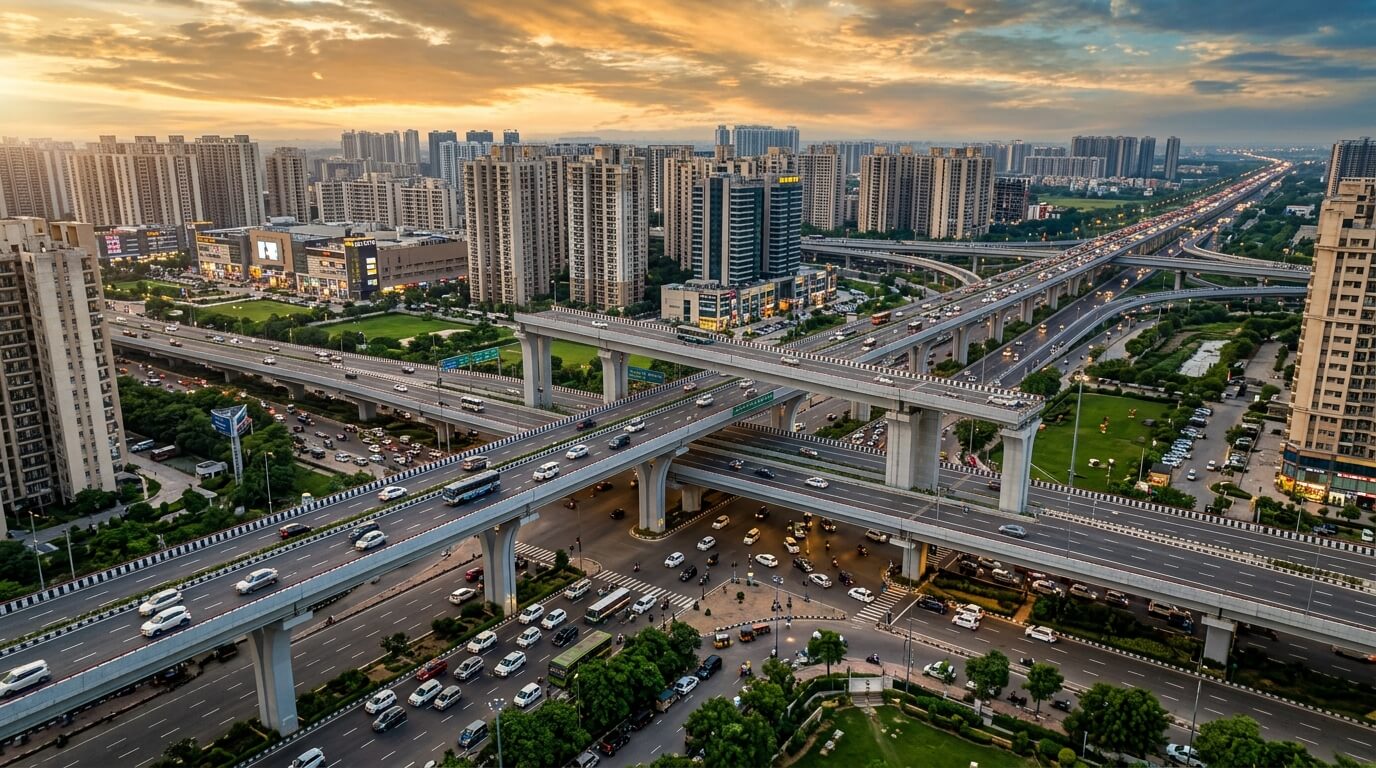
Greater Noida is set to witness a major transformation in its urban infrastructure with the proposed construction of the city's first double-decker flyover. The ambitious project will connect Greater Noida West, Shahberi, and Crossings Republik, significantly improving traffic flow and regional connectivity. Once completed, the flyover is expected to reduce congestion, shorten travel time, and support the rapidly growing residential and commercial developments across the region.
2.5 KM Double-Decker Flyover to Improve Connectivity
The proposed flyover will span approximately 2.5 kilometres, beginning from Eteda Roundabout in Greater Noida West and extending to Crossings Republik via Shahberi. The project will be executed by the National Highways Authority of India (NHAI) as it connects with the Delhi-Meerut Expressway. Construction is expected to be completed by 2028, following the preparation and approval of a Detailed Project Report (DPR).
Project Cost Revised to ₹900 Crore
The estimated cost of the project has been revised to approximately ₹900 crore, more than double the earlier estimate of ₹400 crore that was allocated for a conventional elevated road. The project cost will be jointly shared by the Greater Noida Industrial Development Authority (GNIDA) and the Ghaziabad Development Authority (GDA).
Why a Double-Decker Flyover?
Initially, authorities planned to construct a four-lane elevated road. However, technical studies revealed that the existing road passing through Shahberi is only 14 metres wide, whereas a conventional four-lane elevated road requires a minimum width of 15 metres.
To overcome this limitation, planners opted for an innovative double-decker flyover design, which can be accommodated within a 12-metre corridor while preserving the existing road below.
The flyover will feature two independent decks:
- The upper deck will carry traffic from Greater Noida West to Crossings Republik.
- The lower deck will handle vehicles travelling in the opposite direction.
The structure will be supported by U-shaped pillars, allowing uninterrupted traffic movement beneath the flyover during construction and after completion. This design minimizes land acquisition, reduces traffic disruption, and limits road closures.
A Solution to Increasing Traffic Congestion
Over the past decade, Greater Noida West, Shahberi, and Crossings Republik have emerged as major affordable housing destinations in the NCR. Thousands of residents commute daily to Noida, Delhi, Ghaziabad, and Greater Noida for work.
The Shahberi corridor currently experiences heavy congestion due to:
- Daily office commuters
- School buses
- Commercial vehicles
- Delivery trucks
- Auto-rickshaws and local transport
Traffic conditions worsen further during the monsoon season because of waterlogging and poor road conditions, making infrastructure improvement a necessity rather than an option.
Benefits of the Double-Decker Flyover
Upon completion, the flyover is expected to deliver several long-term benefits:
- Faster connectivity between Greater Noida West, Shahberi, and Crossings Republik.
- Direct and smoother access to the Delhi-Meerut Expressway.
- Significant reduction in travel time.
- Improved traffic flow throughout the corridor.
- Better connectivity to Noida, Delhi, and Ghaziabad.
- Enhanced urban mobility for residents and businesses.
The project will strengthen the transportation network while supporting the region's future residential and commercial expansion.
Impact of the Double-Decker Flyover on Greater Noida West Real Estate
Beyond easing traffic congestion, the proposed flyover is expected to become a major catalyst for real estate growth across Greater Noida West, Shahberi, and Crossings Republik.
Infrastructure development has consistently played a crucial role in increasing property demand and capital appreciation. Improved road connectivity makes residential locations more attractive to homebuyers, investors, and businesses alike.
With seamless connectivity to the Delhi-Meerut Expressway, residents will enjoy shorter daily commutes to Noida, Delhi, Ghaziabad, and East Delhi. Reduced travel time is likely to increase demand for residential projects, especially among working professionals seeking affordable housing with excellent connectivity.
The improved transportation network is also expected to encourage the development of:
- Retail complexes
- Office spaces
- Educational institutions
- Healthcare facilities
- Hospitality and commercial establishments
For developers, the flyover presents an opportunity to enhance the value proposition of both existing and upcoming residential projects, as connectivity remains one of the most influential factors in property buying decisions.
A Positive Outlook for Future Growth
The proposed double-decker flyover represents a significant step toward building a more efficient and sustainable transportation network in the NCR. By reducing congestion, improving accessibility, and supporting economic activity, the project is expected to enhance the overall quality of urban life.
As Greater Noida West continues to evolve into one of NCR's fastest-growing residential destinations, infrastructure projects like this will strengthen investor confidence, boost property values, and create long-term opportunities for homeowners, businesses, and real estate developers alike.